

Oh dat Enneagram
Wanna go beyond personality types? It's a cosmic transformer.

I will admit it. I’m a six.
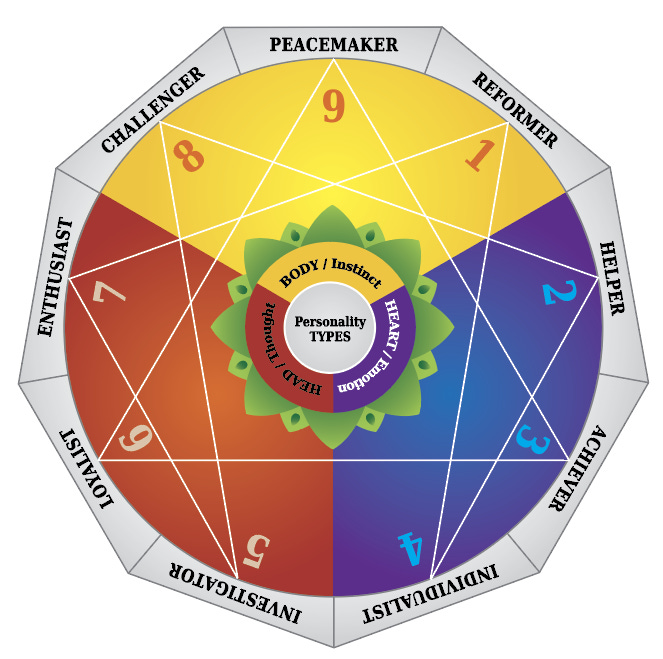
I don’t know when I became a six or if I chose it out of a hat, but being a Loyalist is not such a bad thing. I famously kept the faith through several marital battle zones, and also stayed loyal to my Sufi teacher for 25 years — but probably past the point of maturity.
I’m a bit glib about personality types because I favor the original Enneagram — the one that G.I. Gurdjieff introduced to his students in St. Petersburg during the Bolshevik Revolution (1915–1917) and published from notes taken by P.D. Ouspensky.
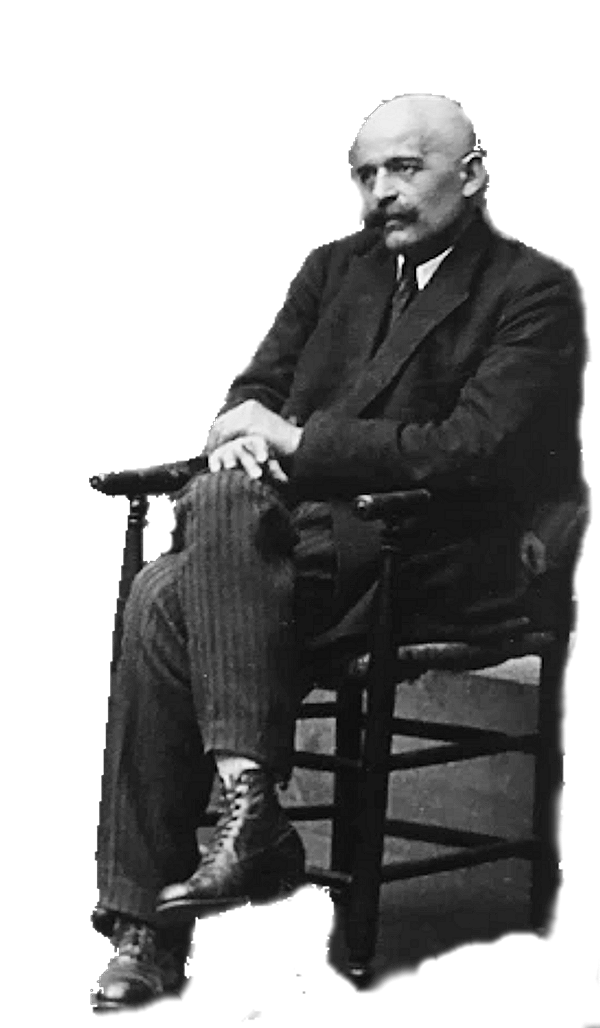
Gurdjieff was an original thinker, but also a man of mystery. He claimed that his knowledge came from a secret society founded in Babylon about 2500 B.C., the Sarmoung Brotherhood. Gurdjieff also traveled to an ancient monastery on Mount Athos in Egypt and may have uncovered an enneagram-like symbol there.
The personality-type Enneagram has its roots in the work of Bolivian psycho-spiritual teacher Oscar Ichazo in the 1950s and the Chilean psychiatrist Claudio Naranjo in the 1970s.
Helen Palmer unleashed the current Enneagram popularity through her book in 1991.
Today, the word “enneagram” almost always refers to personality types (Peacemaker, Loyalist, Achiever, etc.). This is a different use of the symbol than what Gurdjieff introduced.
Here’s why the distinction between Gurdjieff’s and the personality Enneagrams matters to me:
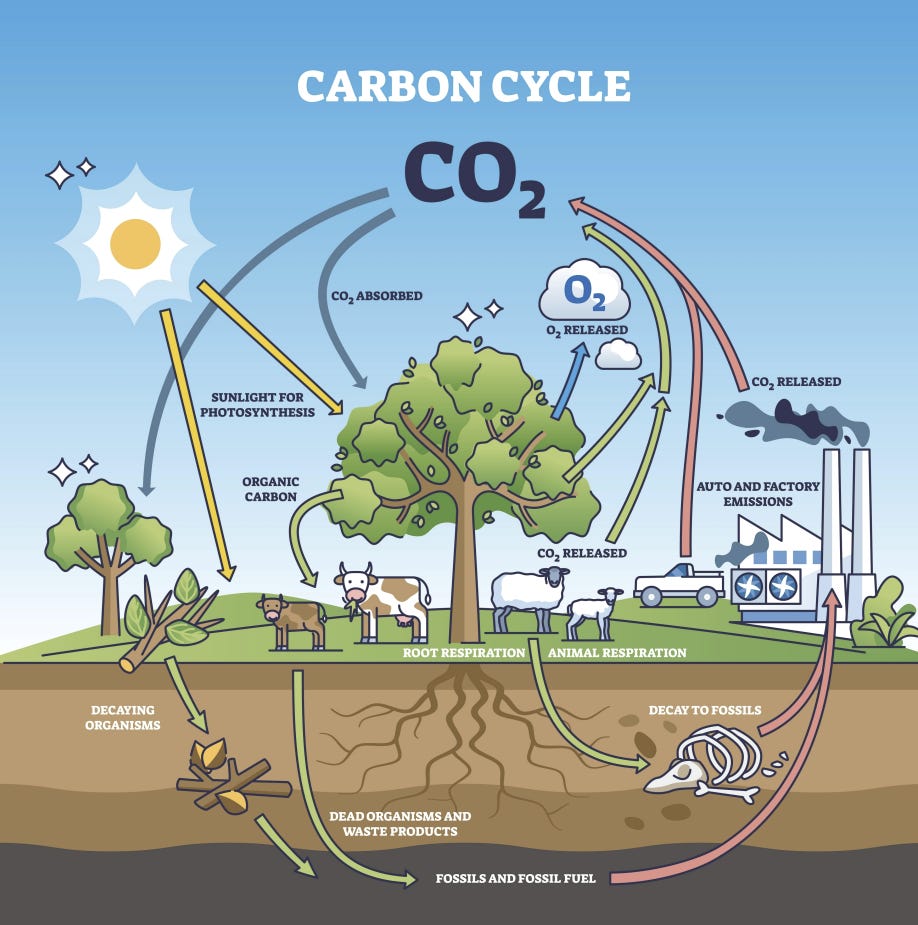
If you think of the Enneagram as a tree, the numbered types are more like hanging ornaments on a Christmas tree than expressions of the tree’s function.

The original Enneagram functions like a living tree with its dynamic processes: Photosynthesis, respiration, absorption, and decomposition.
The mathematics of the Enneagram gives it its dynamism and motion. Here are the elements of the diagram.
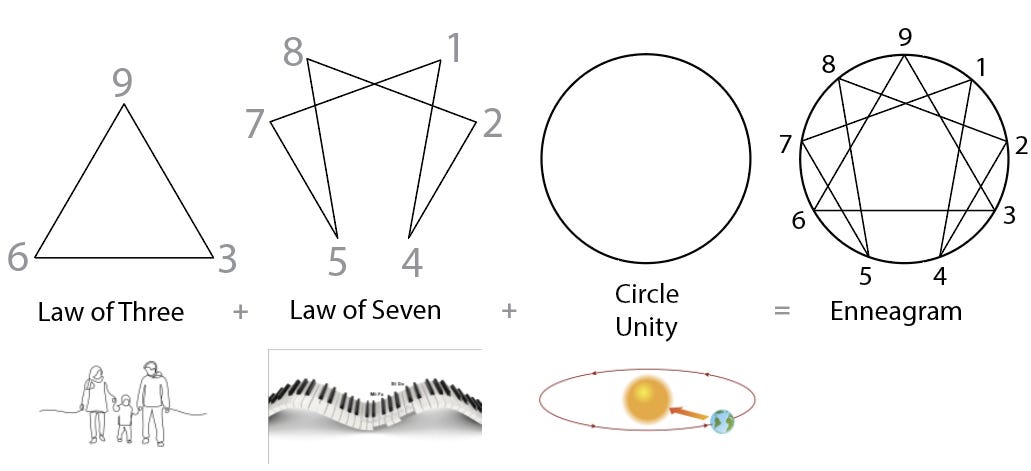
The Law of Three underlies all relations and how they are a product of three forces:
Mother/Father/Child
Father/Son/Holy Spirit
High Pressure/Low Pressure/Precipitation
Positive/Negative/Ground
Plaintiff, Defendant, Jury
Comedic Set-up/Complications/Resolution
Active/Receptive/Reconciling.
When conflicts are resolved, the Reconciling force manifests as grace.
The Law of Seven describes transformation and unfolds like the musical scale, including:
The narrative arc of a novel.
The dramatic structure of a screenplay.
A song structure with its 1. intro, 2. verse, 3. chorus, 4. verse, 5. chorus, 6. bridge, 7. chorus, and outro.
And all human endeavors with ups and downs, including love relationships, projects, trips, healing journeys, campaigns, and missions.
The Circle describes the cyclical nature of life:
Seasons
Planetary orbits
The eternally recurrent nature of time
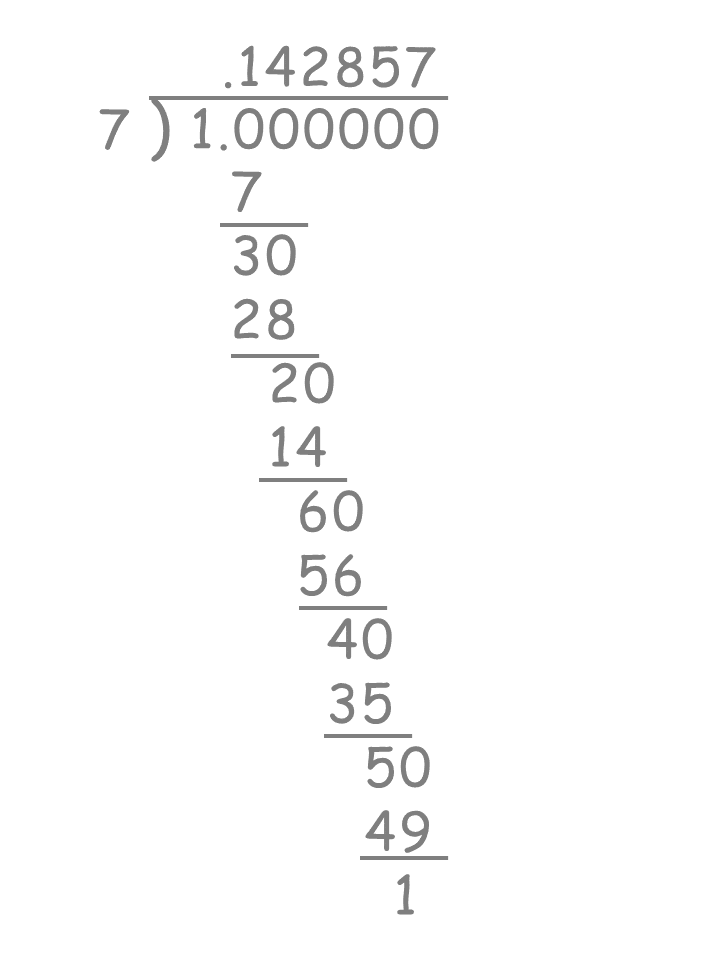
The Inner Lines repeat into infinity:
If you divide 1 (unity) by seven, you get an infinitely repeating sequence 1-4-2-8-5-7 that forms the inner lines.
So, what are we supposed to do with Gurdjieff’s Enneagram?
Gurdjieff was rather coy when he introduced it in 1916, announcing:
“The knowledge of the Enneagram has for a very long time been preserved in secret, and if it now is, so to speak, made available to all, it is only in an incomplete and theoretical form without instruction from a man who knows.”
Gurdjieff made it very clear that the Enneagram is dynamic, in motion — like life itself:
“In order to understand the Enneagram, it must be thought of as in motion, as moving. A motionless Enneagram is a dead symbol; the living symbol is in motion.”
Gurdjieff never wrote about the Enneagram, so all we have are Ouspensky’s notes of his talks — pretty much saying you’re on your own.
People ascribe magical powers to the Enneagram, but it’s just a map — a two-dimensional blueprint of the richness, hazards, and transformations of lived experience. You can use a map of Rome to guide you to the Piazza Navona, but it doesn’t show the hawkers, musicians, and gelato carts you encounter along the way. You have to live that.
Conversely, if you wander the alleyways without a map, you lose the big picture. The Enneagram helps you understand the rhythms and pitfalls of your journey.
Similarly, the Enneagram only makes sense to soul travelers — people working on their “soul project.” As a traveler, you learn to expect long uphill climbs, eccentric characters, and rest stops along the way.
On a soul project, you face the pressures of your growing edges – following a guru, navigating a career, mending a relationship, clearing a trauma, mourning a loss, or following a keto diet. A zillion self-help books teach these edges. Which growing edge should you work on?
The soul’s journey is inseparable from the events of life.
When Bennett encountered the Enneagram as a student of Ouspensky, rather than trying to figure it out, he let it come into him
“I remember vividly when I first saw that the Enneagram was a picture of myself,” Bennett recalled. “Mr. Ouspensky was giving a lecture on the Enneagram somewhere about 1924 and asked me to put the diagram on the blackboard. As I was drawing the familiar lines, I felt myself going out of myself and entering the diagram. I noticed that I was facing myself and grasped for the first time the essential difference between the two sides of our bodies. How long this lasted, I don’t know, but from that evening, I was convinced that the Enneagram is a living diagram and that we can experience ourselves as Enneagrams.”
The Enneagram is a snapshot of your soul project.
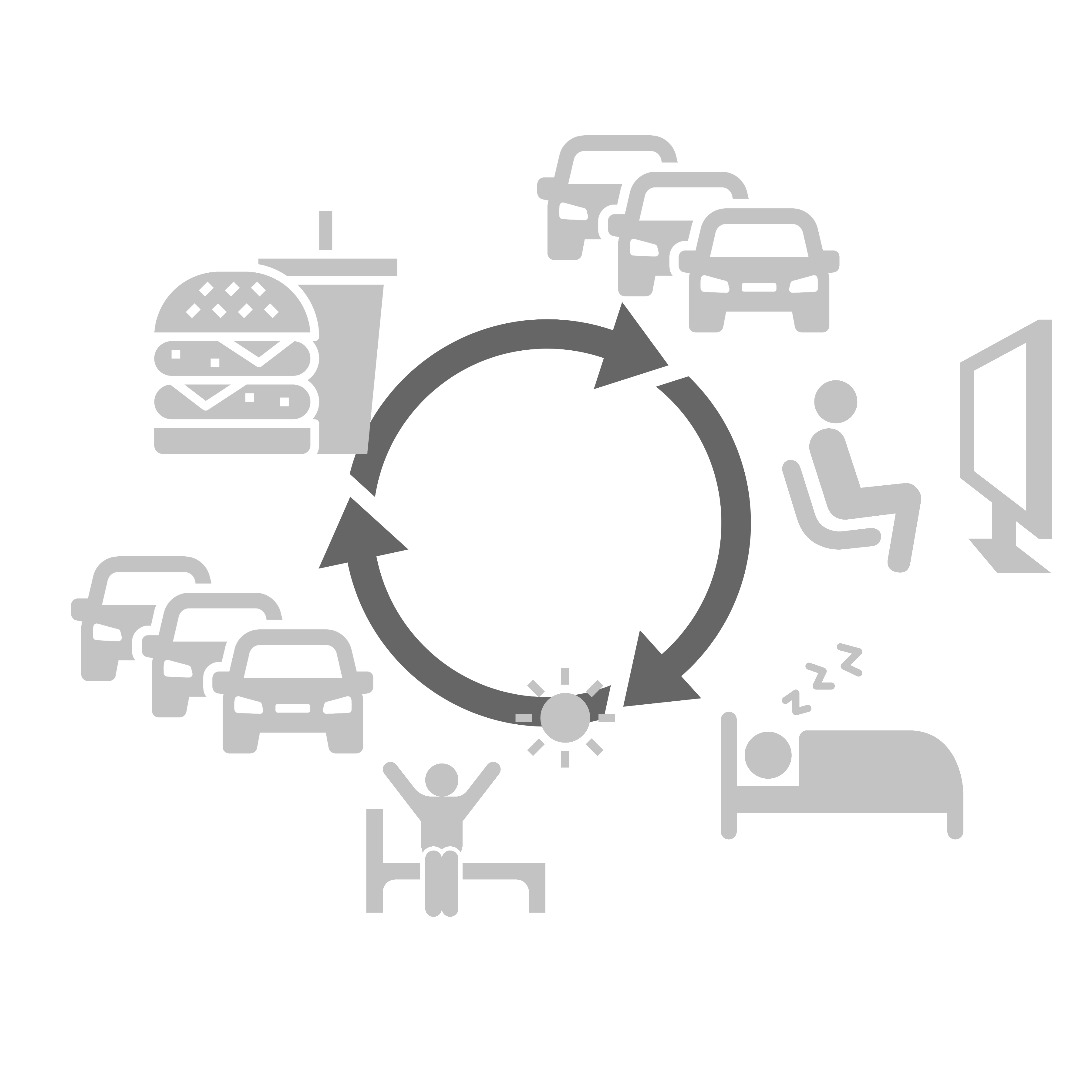
The outer circle represents cyclical time. Your daily routine might include sleeping, getting up, commuting, eating, driving home, watching TV, and then going to sleep again.
The inner lines connect to the future coming in.
If you’re at point 1, influences from point 7 may ping you from the future. Consider the example of a high school junior:
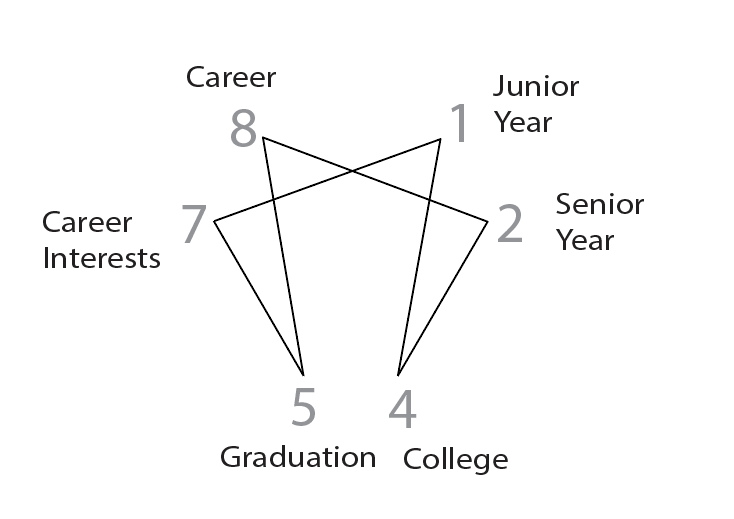
As a Junior in high school, suddenly (and shockingly), playtime is suddenly over. You need to be practicing for the SAT, visiting schools, worrying about your GPA, and thinking about your career interests.
As a High School Senior, College and Career loom even closer. If you’ve been accepted for college, you can kick back.
As a College Graduate, getting a job becomes urgent. The inner lines of the Enneagram represent thoughts, feelings, and influences from the future entering the present.
Entering a marriage is like stepping into the Enneagram.
My teacher Reshad Feild, spoke of the Two Trains — the train that you’re on in the present moment and the train coming toward you from the future.

The “Marriage Train” enters a relationship with a feeling of great promise — a train filled with angels. But these are rough-and-tumble angels inviting us on a harrowing journey. It’s an Octave journey with seven distinct stages:
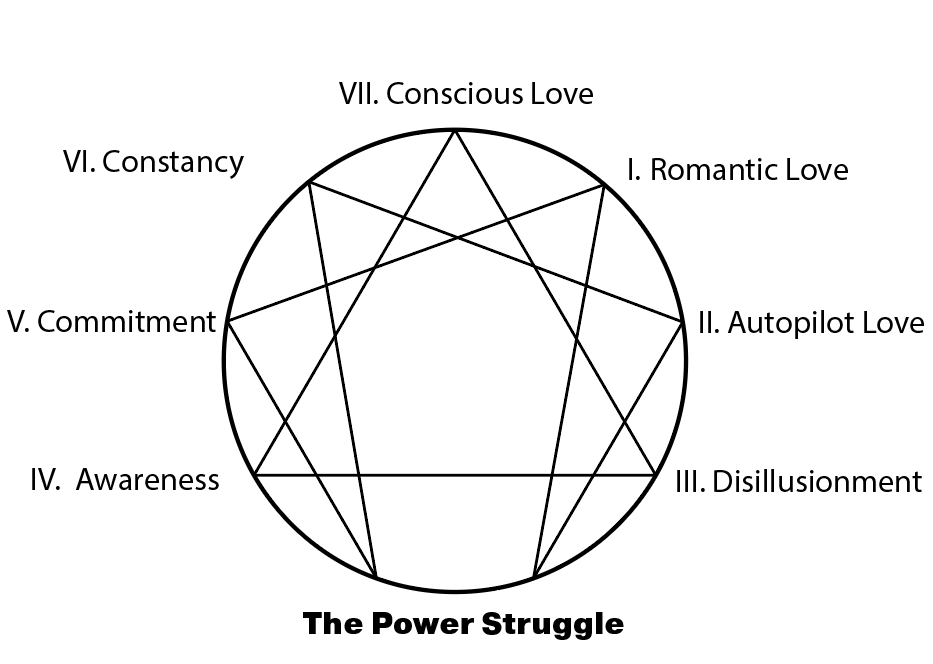
Stage I: Romantic Love — Love Under the Influence (Do)
When we fall in love, our brain becomes flooded with the neurochemical phenylethylamine, a compound found in chocolate that lifts our mood. Neurochemicals like phenylethylamine increase our buoyancy, diminish pain, and cause us to feel safe. By adding sexual hormones to the mix, we become neuro-anesthetized to the degree needed to commit to a relationship. If we could see the hurdles ahead, why would anyone choose to get married?
Stage II: Autopilot Love — Life becomes rote (Re)
Married life quickly becomes tactical. “Bring home some Pampers; let’s go to Ikea; the toilet is clogged.” No one is paying attention, but the tactical and practical slowly smother the magic. When we lose curiosity toward the person who shares our life, the promise of love flattens like soda fizz.
Stage III: Disillusionment — Self-Protection (Mi)
Four love-killing words doom a relationship: “Getting My Needs Met (GMNM).”
Once the phenylethylamine wears off, you face life with another human being. Think of Stage III as the masked ball moment when the mask comes off. It’s too soon to understand, but you were drawn to GMNM, not to the person. In a better system, you would choose your spouse by studying the parents (think of this as seeing the future come in), but it’s too late. Your partner is facing a midlife crisis while you face your own. “Who is this person!!!???”
The midlife crisis invariably hits around age 42 from the pressure of the future coming in. Our death serves as the final boundary. It begins to exert pressure even though it‘s decades away. With a midlife crisis, your soul project is sending a memo: Integration of your life story begins now.
The Power Struggle — (Mi-Fa Interval)
The seeds of the Power Struggle can emerge at any time — even while planning the wedding. The feeling of disillusionment makes us dislike many of the things that attracted us to our partner in the first place. The fun-loving personality seems loud and obnoxious; the practicality and reliability suddenly become stultifying and boring.
A key issue defines your struggle: infidelity, sexual/emotional needs, financial stability, or addiction.
The line in the sand becomes a wall of despair. The hidden engine of continuous renewal requires passage through this Mi-Fa interval, but what will it take? Couples therapy? Trial separation? Ayahuasca? A guru from India? A jar of Bondo™? How about good-old-fashioned grace? (Affirming Force, Denying Force, Reconciling Force).
Stage IV: Awareness — Self-reflection, Imago awareness (Fa)
Marriage offers a custom-tailored opportunity for soul growth. To reach Stage IV, you need to be on a soul project — otherwise, you may split up or move to separate bedrooms.
Psychologically and spiritually, you subconsciously seek a partner who will help you become whole and complete. You experience how your partner pushes buttons and triggers wounds at this stage, but you also recognize that they are your buttons and wounds.
Imago is Latin for “image” — the “unconscious image of similar love.” In Imago Relationship Therapy, the wounding and frustrations of childhood are worked out in an adult relationship. Harville Hendrix, author of Getting the Love You Want, discovered this connection soon after he signed his divorce papers.
Stage V: Commitment — Inner work, solidity (Sol)
It’s been a long journey, but the wedding vows are now realized. “He’s not easy to live with, but I’m not going anywhere.” You’re a team — a dysfunctional one at times — but it’s the team you’re on. Your friends may wonder, “Why do you stick with him/her?” They can’t see the deep satisfaction and synergy that comes from commitment.
Stage V offers a shared history. You’re co-starring in a full-length feature instead of a whimsical short. A change of partners can never replace the richness of your epic saga.
Stage VI: Constancy — A deeper connection steers the ship (La)
Robert Bly described this connection as the “third body:”
“A man and a woman sit near each other, and they do not long at this moment to be older, or younger, or born in any other nation, or any other time, or any other place. They are content to be where they are, talking or not talking… They obey a third body that they share in common.”1
Stage VII: Conscious Love — Transpersonal, Beyond personal needs (Si)
Transpersonal is beyond this world, so how can conscious love be described? Most people experience conscious love after their partner dies. When the partner’s physical presence departs, the being remains. In the Netflix series, The Kominsky Method, after Alan Arkin loses his wife, Eileen, to cancer, Arkin continues to seek his wife’s counsel as though she never left. At the funeral, he speaks to her as present company:
“Dear Eileen, We have been husband and wife for forty-six years. In all that time, I have never not been in love with you. I have been angry with you, confused by you, even hurt by you, but never not in love. If something good happened to me at work, it wasn’t real until I shared it with you. If something bad happened, it was only tolerable because I had you to complain to. I honestly don’t know how I will carry on without you, but I will because you told me to in no uncertain terms.”
A poignant beauty accompanies aging when a couple attends to each other’s limitations. Because of Karen’s vision disability from her brain surgery, I dutifully read every foreign film subtitle, offered my arm at street corners, and massaged reflexology points on her feet nightly. There’s no scoring of points in conscious love.
What about the inner triangle?
The Gurdjieff Enneagram traditionally views the inner triangle as a person’s three centers of intelligence:
Point 9 — Body (Instinctual Center)
Point 3 — Soul (Feeling/Emotional Center)
Point 6 — Spirit (Head/Intellectual Center
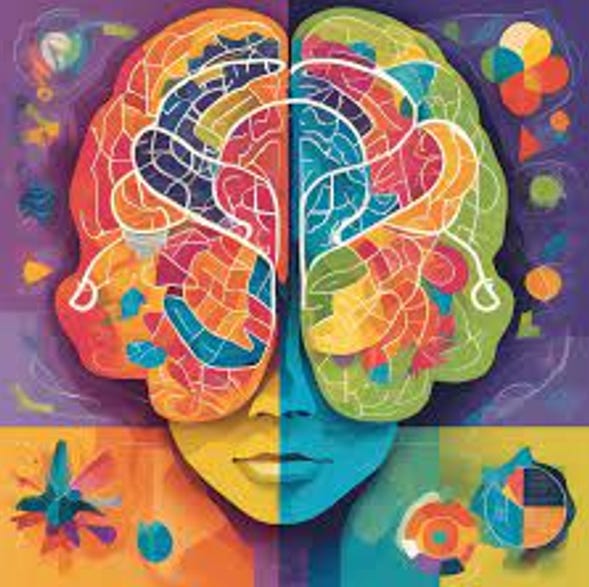
Gurdjieff gave permission to read into it your own way, and I did. I view the inner triangle as our solidifying self, the fruit of our soul’s project. It mirrors the two sides of our brain:
Left Brain Thinking (Diagram right)
Associated with the cerebral cortex, this character is analytical, logical, and focused on details, structure, and planning. It’s the “planner” and “doer” who likes to organize and categorize.
Right Brain Feeling (Diagram left)
.Tied to the limbic system, this character is playful, creative, empathetic, and focused on the present moment and positive emotions. It’s the “explorer” who seeks connection, joy, and new experiences.
Peak of the Triangle
The triangle represents our growing self-awareness, and the peak is our spiritual center. Each trip around the diagram offers opportunities to bring the left and right sides into harmony and to integrate the subconscious. The triangle is who we are as a realized human being. The cool thing about the Enneagram is that it shows our awakened self in the middle of the marketplace.
Can I use this symbol in a practical way?
The Enneagram makes more sense as a talisman — a reminder that you are on a soul journey. It shows us how the karmic challenges we face serve a purpose.
Reshad regularly quoted Gurdjieff as saying (and I haven’t found evidence), “Man is a cosmic apparatus for the transformation of subtle energies.” The Enneagram is the owner’s manual for that apparatus. Have fun with it!
Thanks for reading,
Bruce
Bly, Robert. 2000. Eating the Honey of Words: New and Selected Poems. New York: Harper Perennial.
Very cool I would be interested in your thoughts on this… https://open.substack.com/pub/ronaldingram/p/chapter-10-gurdjieffian-journey-from?r=2xhreu&utm_medium=ios
Unite or fall! #Genius #enneagram
Great article, Bruce!